Dutch Live Music Monitor
The Dutch Live Music Monitor contains an overview of live pop music performances in the Netherlands from 2008 to 2024 and includes 387,048 performances by 42,872 artists. The Monitor not only contains information about the performances, venues, and festivals, but also about the artists (including the number of performances per artist, the number of artists who move on to larger venues, the origin of the artist, and gender ratios), the development of genres, and the geographical distribution of live music. The Dutch Live Music Monitor 2008-2024 was funded by the Boekman Foundation and the Dutch Performing Arts Fund.
The key findings of the report:
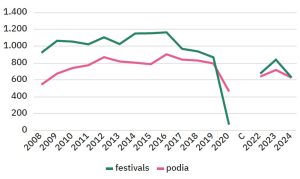
- After the pandemic, there are fewer venues and festivals with pop programming. In 2016, this number was at its highest. In 2024, there were 626 locations hosting pop concerts and 628 festivals featuring pop music.
- After COVID, the number of performances rose to the highest level since measurements began in 2008, while programming takes place across fewer distinct locations. This is partly due to the scaling up of festivals.
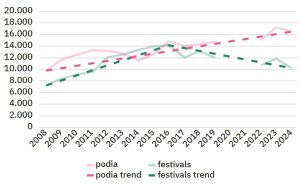
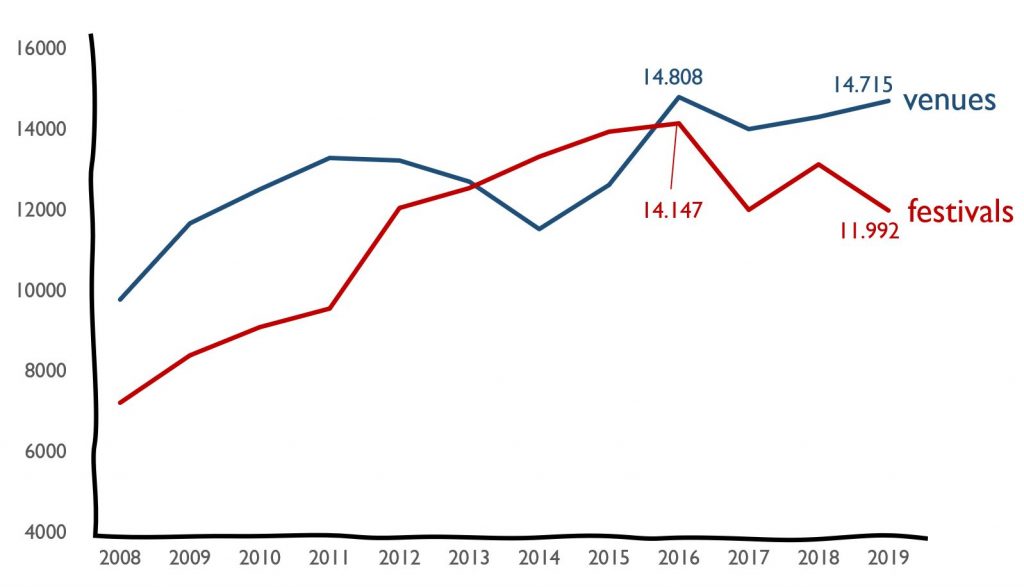
- Defestivalization. In the period from 2008 to 2016, there was a clear festivalization of live music: the annual number of festival performances doubled between 2008 and 2016, from approximately 7,000 per year to around 14,000 per year. The period between 2017 and 2024, however, is characterized by defestivalization; during this time, the number of pop performances at festivals decreased by more than a quarter.
- The share of informal venues declined from 30% to 8% of all concerts between 2008 and 2024. Informal venues are low-threshold, free performance spaces such as music cafés or festivals in public spaces (without an entrance fee).
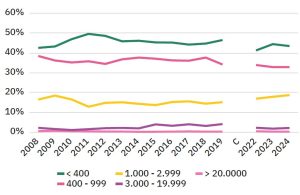
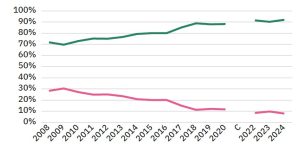
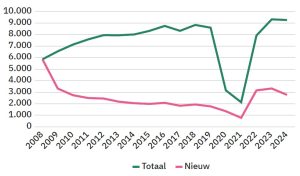
- In 2023 and 2024, more than 9,000 unique artists were active. Of all artists, 40% were active for only one year, and 65% for a maximum of three years.
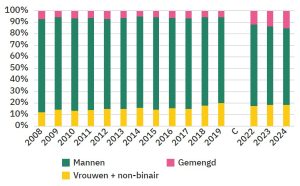
- Men are overrepresented in live performances at venues and festivals. In 2024, 66.5% of performances consisted of artists made up exclusively of men.
- The share of women and non-binary artists grew until 2019, from 11.8% in 2008 to 19.8% in 2019. After the COVID years, this figure has remained around 18%.
- At festivals, all different genres are programmed in more or less equal proportions compared to venues, where certain genres are strongly overrepresented. As a result, festivals are more diverse in their genre programming than venues.
- Pop/electronic and rock were the most programmed genres in 2024.
- Tribute bands and cover artists (performances by artists who play the work of other artists) have increased strongly in popularity. In 2024, nearly 7% of all registered pop concerts in the Netherlands were tribute concerts.
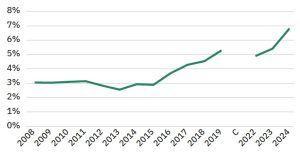
The full report (in Dutch) can be found here.
Dutch Live Music Monitor 2008-2019 (first edition)
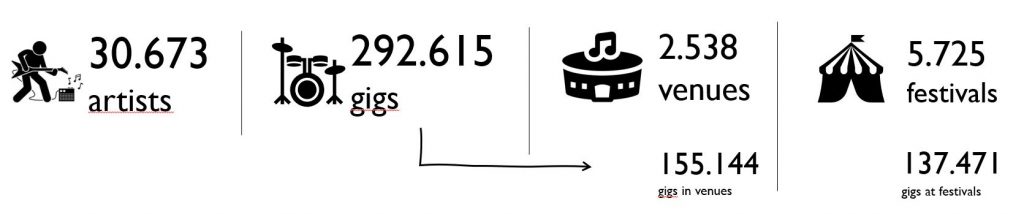
The Dutch Live Music Monitor contains an overview of twelve years of live popular music in the Netherlands (2008-2019). The database was constructed based on the Dutch websites podiuminfo.nl and festivalinfo.nl and multiple additional websites and music databases. It contains 292.615 shows, both in venues and festivals, by 30.673 artists, of which the majority is Dutch. The full monitor can be found here (in Dutch). Below you’ll find some highlights. For more information send an e-mail to Martijn Mulder.
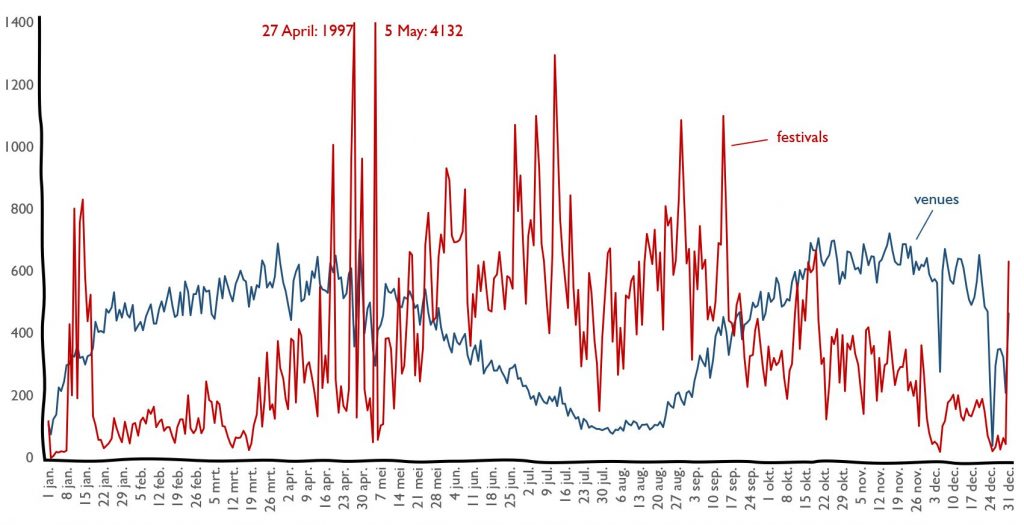
Between 2008 and 2019, the annual amount of gigs has increased by 57%. Between 2008 and 2016, the number of festival shows doubled from 7.000 to 14.000 a year. In the years after it dropped back to 12.000. The supply of venue shows also increased, mainly between 2014 and 2019. The live music calendar shows a clear distinction between the club season and the festival season.
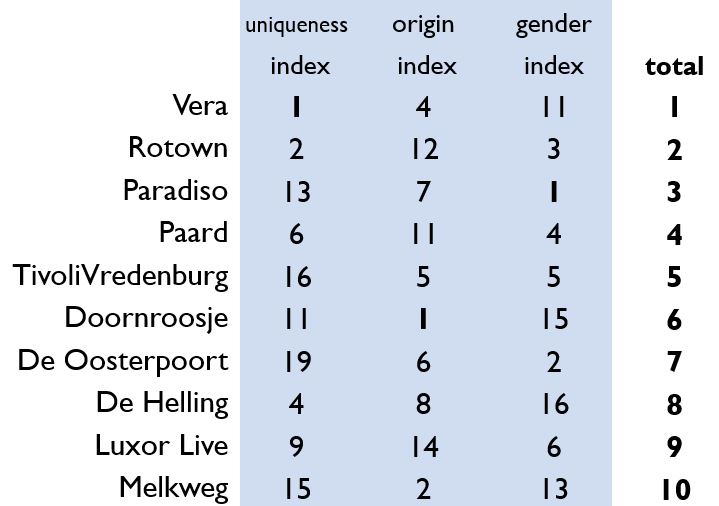
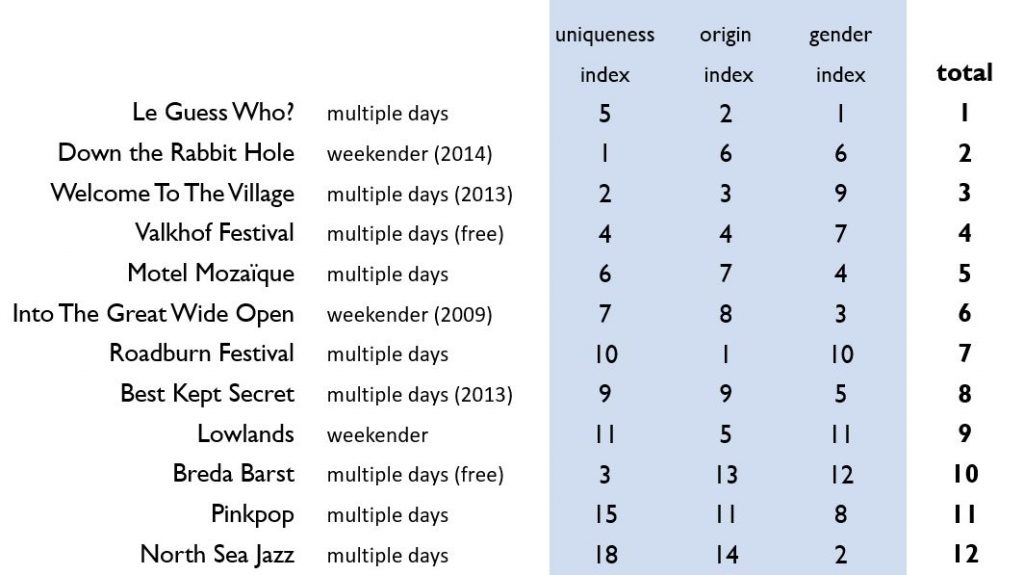
Based on a number of indicators that could be extracted from the data, we developed an index for diversity on stage in venues and at festivals. The index is based on the level of uniqueness of the artists playing the venue/festival (or, the other way round, the amount of artists that return to play the same stage), indicators related to the country of origin of the performing artists and the gender balance of performing artists. Vera (Groningen) and Rotown (Rotterdam) are the venues with the most diversity on stage. Le Guess Who? (Utrecht) is the festival with the most diversity in performing artists.
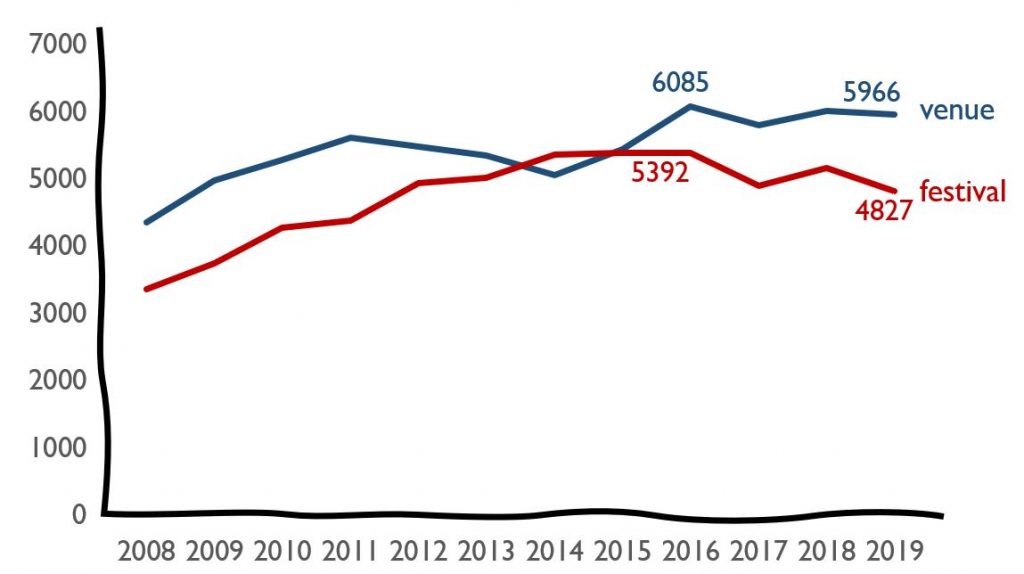
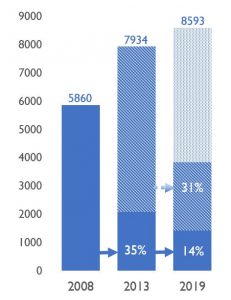
The number of artists playing venues and festivals annually, has increased for both venues and festivals. Also the annual unique number of artistst playing in the Netherlands has grown from 5.860 in 2008 to 8.593 in 2019. Of all artists with at least one gig in 2008, 14% was still performing in 2019.
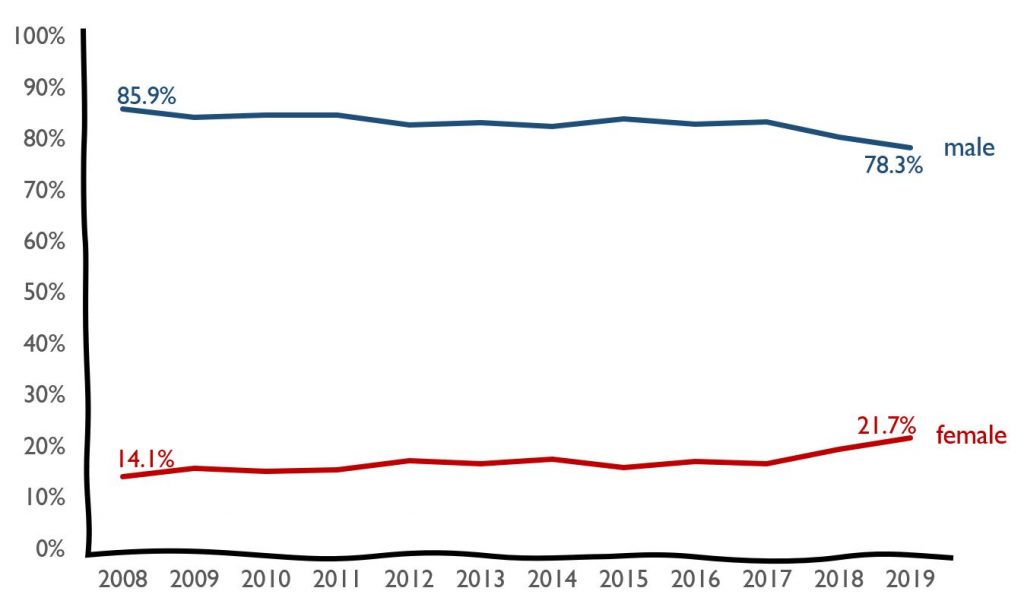
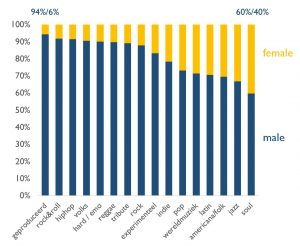
Pop music artists are predominantly men. In 2008, 86% off all performing artists were men, in 2019 this was still 78%. Based on a sample we concluded that of all mixed bands 69% were male band members and 31% female. Based on this sample we integrated the gender-mixed artists in the figures below.
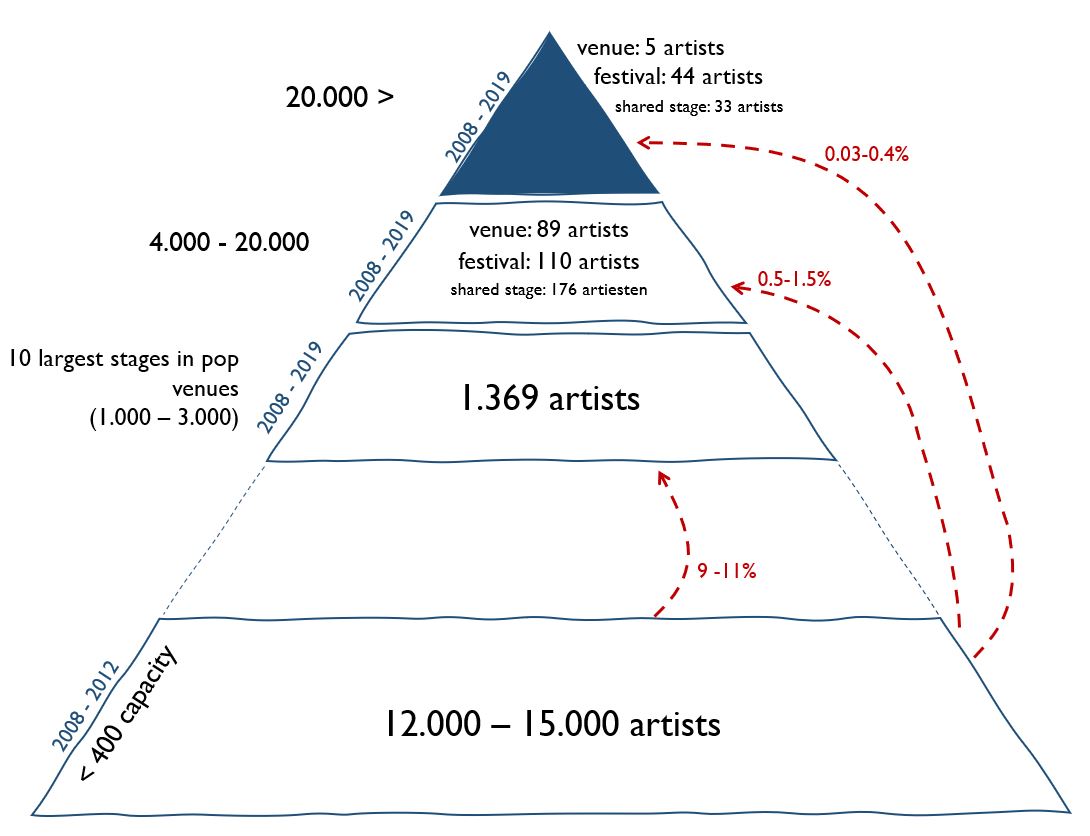
What are the chances of making it big as a beginning artist, playing small crowds? The monitor shows that the chance of making it from the smallest stages (<400) to one of the ten largest stages in Dutch pop venues (e.g. main stage Paradiso) is approximately 10%. The chance of booking a venue show with a capacity of +4.000 is appr. 0.5%.
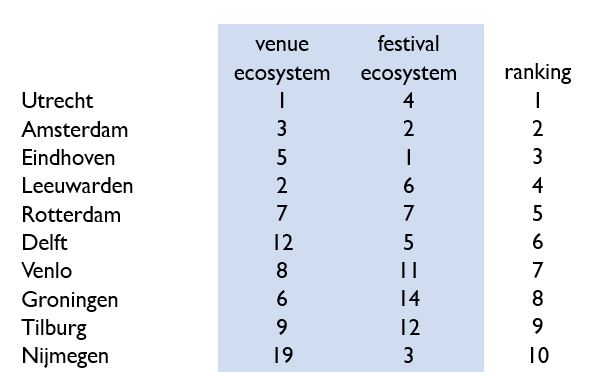
Which Dutch city has the most healthy ecosystem of venues and festivals? Based on several indicators such as the venue-density and the skewness of venue supply, the monitor presents a ranking of the cities with the most healthy supply. Utrecht scored slightly better than Amsterdam. Eindhoven has the healthiest music festival supply.
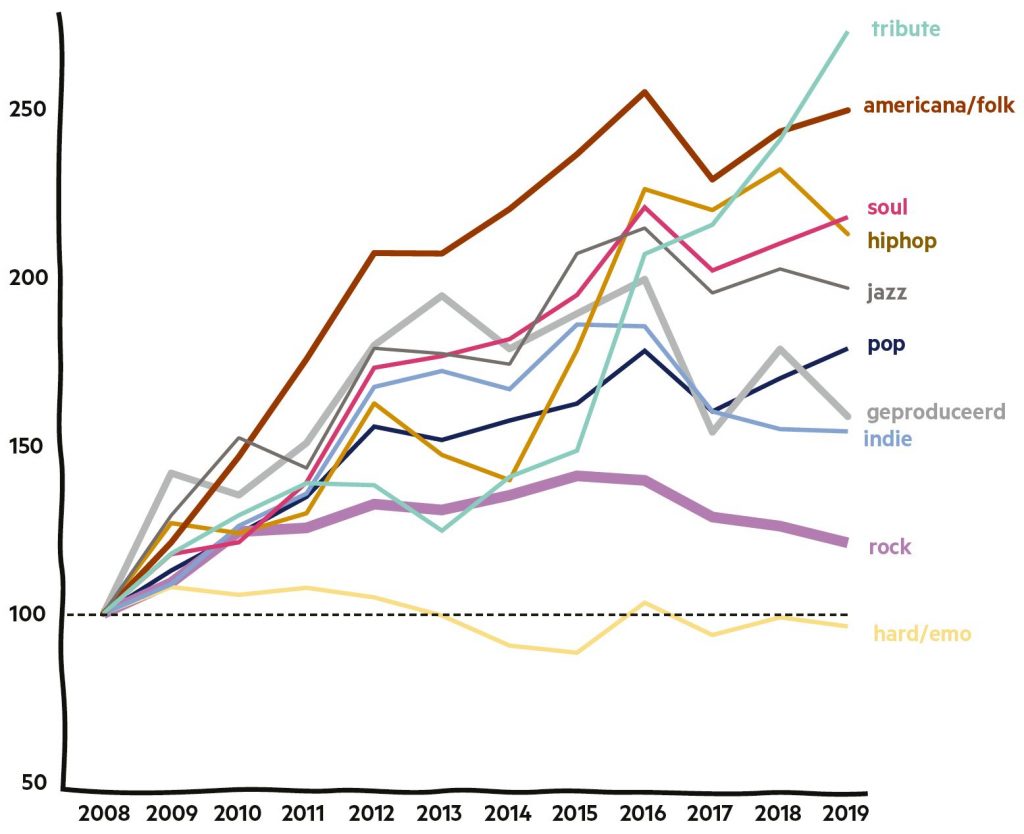
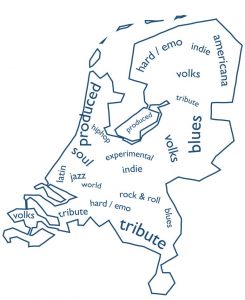
Finally, we analysed the developments in genre between 2008 and 2019. We were able to label the genre (max 3 items per artist) of about 98% of all artists in the database, based on either the channels of the artists themselves, or other relevant data sources. An index shows that the supply of artists playing americana/folk (including singer-songwriters) and tribute artists, has grown even faster than genres such as hiphop, pop and produced music. Finally, a map of the Netherlands shows the overrepresented genres in all regions.